LEADER JEFFRIES: “THE COMMONWEALTH OF VIRGINIA WILL NOW BE PROPERLY REPRESENTED BY AN ACTUAL PATRIOT”
Today, House Democratic Leader Hakeem Jeffries delivered remarks commemorating Barbara Rose Johns of Virginia, who led a two-week student protest in 1951 that led to the landmark Brown v. Board of Education Supreme Court decision. A statue in her honor will now stand in place of Robert E. Lee in the US Capitol.
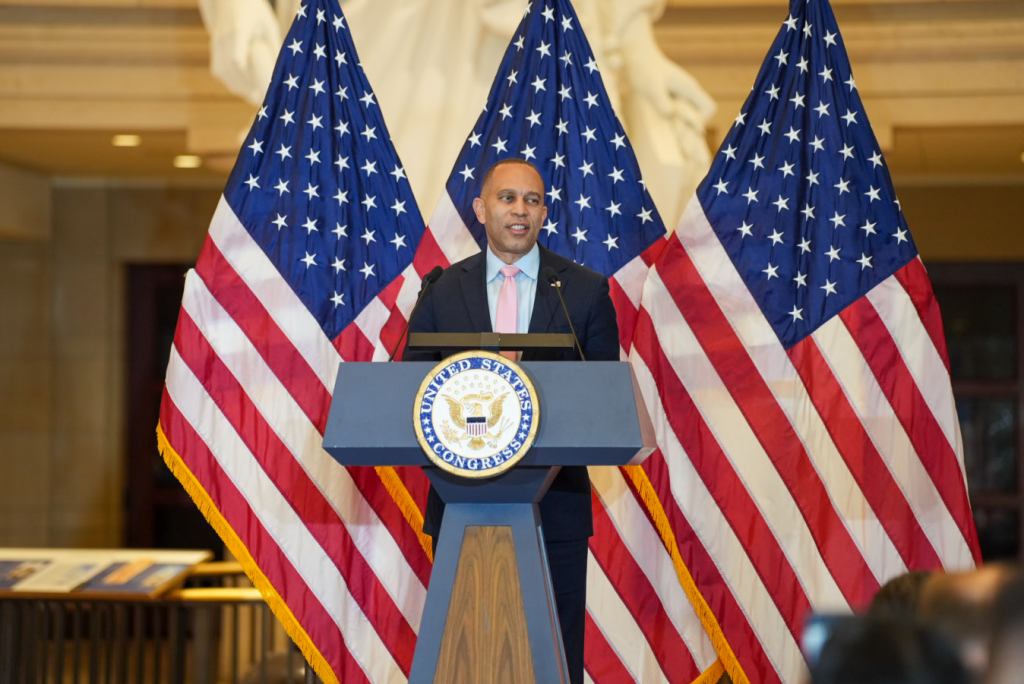
LEADER JEFFRIES: It’s a high honor and a distinct privilege [to] celebrate the statue unveiling of Barbara Rose Johns, a trailblazer, freedom fighter and incredible champion for equality.
She was born in New York City and spent her early childhood in the Big Apple—I had to get that in, y’all—before moving with her family to Prince Edward County, where she attended the segregated Moton High School in Farmville, Virginia. At just 16 years old, this courageous student took a stand and rallied hundreds of her classmates to walk out and not return for two weeks to protest the inadequate and intolerable conditions that they endured at their school.
At the time, Moton High School was badly overcrowded, shabby equipment, no gymnasium, no science labs, poor heating and shaky ventilation. Eventually, an overflow space was constructed, but an overflow space consisting of three poorly-made tar paper shacks. It was a separate and unequal, toxic educational environment.
After bringing these poor conditions to the attention of a teacher, Barbara was dismissively told, ‘Why don’t you do something about it?’ And that’s exactly what she did. In retelling the story, she recalled thinking to herself, ‘this is your moment, seize it.’ Barbara Johns rose to the occasion.
The prophet writes in the book of Isaiah, the eleventh chapter, sixth verse, that ‘a child shall lead them.’ It’s a particularly fitting passage of Scripture now engraved in the statue that commemorates her iconic legacy.
The school walkout that Barbara led on April 23, 1951 sparked the school desegregation movement that ultimately culminated in the landmark Brown v. Board of Education decision. Of the five cases that made it up to the Supreme Court, the Virginia case was the only one that emerged from a student-led movement. That’s Black history. That’s American history. And today we celebrate that history by memorializing a true American hero.
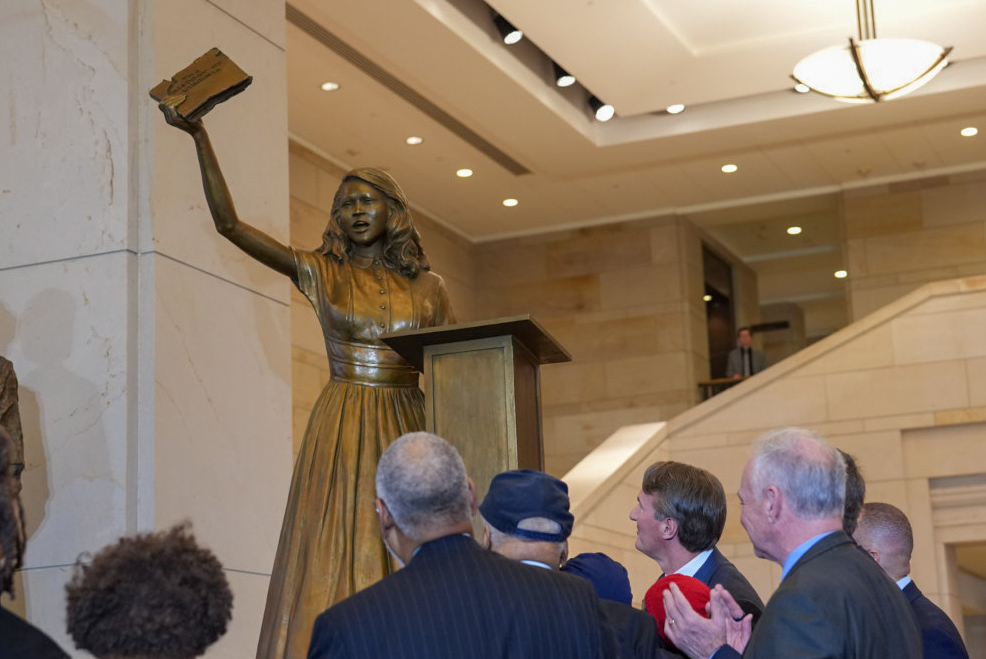
The Commonwealth of Virginia will now be properly represented by an actual patriot who embodied the principle of liberty and justice for all, and not a traitor who took up arms against the United States to preserve the brutal institution of chattel slavery.
At the time of Robert E. Lee’s statue unveiling in 1909, Representative Charles Curtis, a Kansas Republican, who later on went to serve as Senate Majority Leader and our nation’s 31st Vice President, remarked, ‘I think it is a disgrace. He was a traitor to his country, and I will not sanction an official honor for a traitor.’
We can remember our deeply troubled past in museums, but should never be given a place of honor in the halls of Congress.
That is why it is so appropriate and important to elevate transformational trailblazers like Barbara Rose Johns. Her story is powerful, her story is moving, and with this honor, her story will never be erased. A statue of her will now stand in the Capitol, joining the Reverend Dr. Martin Luther King, Jr., Rosa Parks and other iconic heroes, depicting her call to action as a reminder of the progress that we have made in this great country and the work, of course, we must continue to do.
The late great patriot John Lewis encouraged us in the face of injustice to always stand up, speak up and show up for what we know is right. And most importantly, go out there and get into some good trouble.
That’s exactly what Barbara Rose Johns did at 16 years old, good trouble. And because of her brave act of civil disobedience, it led to one of the most consequential Supreme Court decisions in our nation’s history and helped make America a more just version of herself.
Full remarks at the statue unveiling can be watched here.
###